
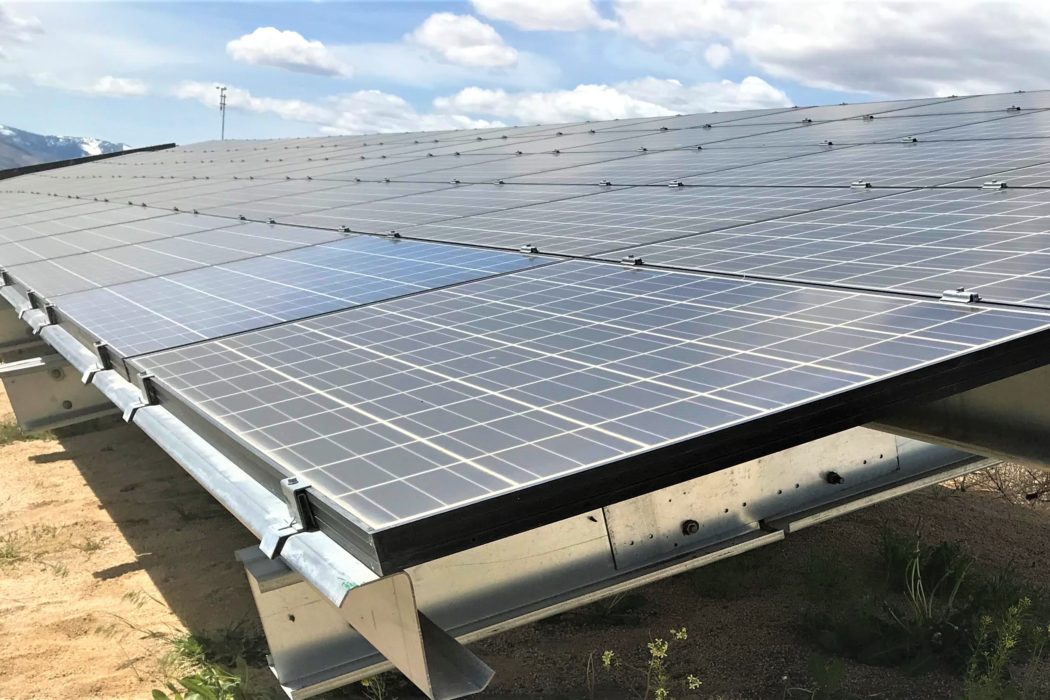
The City of Reno recently concluded a study with the University of Nevada, Reno, through their Community Based Research Award Program to a) baseline existing renewable generation and consumption and b) suggest methods for achieving its renewable energy goals, and once concluded, help define which metric to use to measure the City of Reno goal. Subsequently, the study was submitted to the 2020 North American Power Symposium and was selected for publication.
Many municipal governments wish to power themselves with more renewable energy, whether to combat climate change or as a cost effective alternative in their market. The City of Reno can, should, and is doing their part. In Nevada, there is a large amount of support for renewables, especially solar energy, both within the state government and the largest Investor Owned Utility, NV Energy. This gives municipalities a large number of options for growing their renewable portfolio. This suggestion follows for any other local government situated in a region whose government or power company is not only capable of assisting, but has already implemented the infrastructure to create these changes, whether through financial incentives or through more traditional Command-and-Control styled regulations.
The study analyzed The City of Reno potential for renewable growth, stated various policies that help make a municipality operate more sustainably, and provided policy suggestions.
By the end of the study, the City of Reno concluded it could measure its goal in one of a few ways:
- Renewable Energy production to meet 50% of its peak load (measured in kW)
- Renewable Energy production and policy to meet 50% its consumption (measured in kWh)
- Renewable Energy production to cover specific site load (measured in kWh)
The City of Reno concluded could meet its end of 2020 goal of 50% renewable electricity for its peak operational load. It has successfully reduced its carbon footprint by using PPAs, net metering, and various energy saving initiatives; mostly through lighting projects and building recommissioning. The City of Reno existing developments generate 189 GWh monthly in the winter months – a time period one can expect lower production.
| kWhD | kWhR | kWhN | kWhG (Generation) | Solar Consumed (kWhG – kWhR) | Need (kWhG – kWhR + kWhD) | Percent (kWhG / Need) |
| 207510 | 11858 | 195652 | 81839 | 69981 | 277491 | 29% |
The study also found City of Reno can also rely on some clean grid power thanks for the State’s robust Renewable Portfolio Standard and NV Energy’s current compliance. Accomplishing the objectives suggested in the study will help to not only achieve the City of Reno goals, but also drive the local economy and advance movement away from fossil fuels. Each year, Nevada’s Renewable Portfolio Standard requires all electricity providers to offset a percentage of the electricity they sell at retail with the production of renewable energy. This means that NV Energy, as the City of Reno’s electricity provider, is already producing renewable energy on its behalf. Therefore, the City of Reno can meet its goal by producing or procuring enough renewable energy in addition to what NV Energy is already producing to reach 50 percent of the City of Reno annual consumption.
The table below shows what percentage the City of Reno must produce or purchase in order to meet its goal of 50% in 2020 at the sites in which the City of Reno has solar. This compares site consumption vs. production, only. The assumptions are that NV Energy exceeds PUCN standards by: nothing, 4%, 3 years, or 2 RPS sections, meaning they will be making 34%, 38%, 42%, or 50% respectively. The safest assumption would be to follow the median and say by 2025, NV Energy will be providing Reno with at least 40% renewable energy. 40% is also what NV Energy themselves assume, according to their 2019 RPS Compliance Report.
Displaying possible levels of NV Energy renewable penetration correlated with how much energy Reno must use renewably for their goals
| 2020 | 2025 Min. | 2025 + 4% | 2025 + 3 years | 2025 + 2 sections | |
| NV Energy % | 29.4% | 34% | 38% | 42% | 50% |
| Reno % Goal | 50% | 100% | 100% | 100% | 100% |
| Reno Gen % Required | 29.2% | 66% | 62% | 58% | 50% |
Many of the City of Reno gains made will likely come from saving energy, rather than producing new energy. The study found that there is no one answer to meet the City of Reno renewable energy goals – it will have to be a combination of policy supported efforts and production, as well as clearly define its goal. Local and state policy and the Renewable Portfolio Standard (RPS) will play a key role.
The City of Reno will provide an update on this and other goals under its Sustainability Plan on September 3, 2020 via a webinar hosted by the Nevada Green Business Network.
Blog By: Suzanne Linfante, City Manager’s Office, Sustainability Program; and Matthew Egan, Student with the University of Nevada, Reno.