
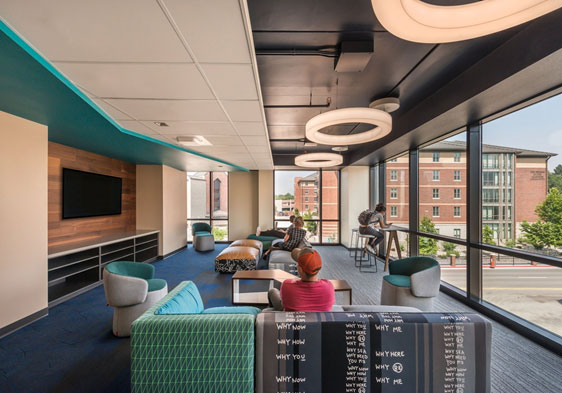
In January, Great Basin Hall receives LEED Gold Certification becoming the newest LEED certified building in our community. Great Basin Hall replaced White Pine Hall and increased occupancy of the building to 400 from its previous 100. This recognition makes the dorm the second LEED Gold certified building on campus and one of four LEED certified buildings developed by the university.
All new facilities built at the University are required to meet a minimum of level of LEED Silver Certification or equivalent, as stipulated by the University Design and Construction Standards.
Van Woert Bigotti Architecture, a Reno-based firm, designed the dormitory, and CORE Construction was the contractor for the project. UNR and the project team committed to achieving LEED Gold certification from the start of the project. The team also included Brightworks Sustainability, a national leader in sustainability consulting, which provided LEED services. Great Basin Hall will join ranks of other LEED-certified buildings on campus, including Peavine Hall (Gold, 2015), Nevada Living Learning Community (Silver, 2012), and Marguerite Wattis Peterson Athletic Academic Center (Silver, 2008).

Desert Research Institute C.A.V.E.
Great Basin Hall incorporates energy and water saving systems, such as LED lighting, natural daylighting to reduce the need for interior lighting during the day, energy-efficient windows, and low-flow water fixtures. It also features recycled building materials. Van Woert Bigotti combines passive design principles that utilizes daylight to improve energy performance while creating a healthier environment for residents.
Van Woert Bigotti Architecture is one of the community’s leading design firms that consciously integrates sustainable design into projects. Their approach to balancing sustainable design and aesthetics is what differentiates Van Woert Bigotti in a competitive market. CORE Construction also helps clients achieve their green building goals. As a member of the U.S. Green Building Council, CORE is well versed in implementing green building practices, from construction waste recycling programs to sophisticated solutions for LEED certifications. CORE’s many LEED accredited professionals provided added support green building on any project team.

Bently Heritage
In addition to Great Basin Hall, Van Woert Bigotti also designed the Desert Research Institute C.A.V.E Facility, (Gold, 2010). The team accomplished this goal, while also meeting the project objectives to create repetitive research spaces along with shared collaborative spaces on a restrictive budget. Van Woert Bigotti also designed the Sierra Nevada Job Corps Center Cafeteria (Silver, 2019), and the Bently Heritage Estate Distillery (Gold, 2019) building in Minden. Originally constructed in 1906, the Bently Heritage is a century-old landmark listed on the National Register of Historic Places. The team worked closely with the Nevada Historic Preservation Office and the National Parks Service, and followed the National Park Service Historic Preservation Standards and Guidelines. The owners, Christopher and Camille Bently, wanted to preserve and protect the building for future generations, and focused on preserving existing elements within the building rather than replacement.
YOUnion Student Living, while not owned by the university, is another LEED Silver certified student housing project. Energy efficient windows and kitchen appliances, programmable thermostats and lighting, on-site recycling, a carpool and ride-share program, bum-a-bike program, low-flow water fixtures, drought-tolerant landscaping, and green cleaning program encompass the eco-friendly lifestyle offered.
Developed by The Dinerstein Companies (TDC), this project is one of more than 20 LEED certified projects built by TDC since 2011. The company is committed to achieve LEED Silver certification or higher on 100% of its projects.
The City’s Goal is to Encourage Green Building as Standard Practice
Green buildings help keep our businesses competitive and attract talented professionals. LEED certified buildings use 25% less energy and generate 33% lower carbon emissions. They also lower operating costs 13% for new construction and 8.5% for existing buildings, and increase building value 10.9% for new construction and 6.8% for existing buildings. Their owners also report 27% higher occupant satisfaction, improved occupant health, increased worker productivity, and reduced absenteeism. These are important contributions to profitability. It also explains why 41% of commercial space in America’s 30 largest office markets are LEED or ENERGY STAR certified.
While most industry professionals in Reno believe green buildings cost more, studies show that green buildings are achievable at minimal to no additional costs for new construction when the team utilizes an integrated design process. Incremental costs for major renovations are 2-4% on average, with a return on investment within three years—the time it takes to recoup added costs. More importantly, the initial construction costs represent only 2% of the 30-year costs of the building.
Green building also has a significant impact on our economy. In Nevada, a study projected the cumulative impact of the green building sector from 2015-2018 to comprise 200,000 jobs that generated $11.33 billion in wages, and contributed close to $17 billion to the state GDP.
- Explore the City of Reno’s Sustainability & Climate Action Plan
- Sign up for updates on Reno’s sustainability and climate news
- For assistance with a green building project contact our team at ReEnergize@reno.gov
Photos courtesy of Van Woert Bigotti. Vance Fox Photography.