
We are entering an era where the environment is at the forefront of most everyone’s minds. Many business leaders believe that corporate social responsibility (CSR) and sustainable business practices offer their organizations a competitive advantage. In fact, over 90% of the 250 largest companies in the world track and report their progress toward CSR and sustainability goals. In business, CSR and sustainability help organizations to achieve financial goals and strengthen their corporate brand, while also enhancing society and the environment.
One sector that has established leadership and innovation in sustainable business practices is the aviation industry comprised of airlines and airports. In fact, on February 5, 2020, the UK Sustainable Aviation coalition announced its commitment to reach zero carbon emissions by 2050. This commitment is backed by its Decarbonization Road-Map: A Path to Net Zero Emissions. The Road-Map identifies a range of decarbonization opportunities, including new aircraft technology, sustainable aviation fuel, market based measures such as utilization of carbon pricing and carbon sinks, and modernizing through airspace improvements. The commitment and Road-Map is a bold step for an industry that accounts for approximately 2% of greenhouse gas emissions worldwide, and for which emissions are rapidly increasing. Aviation industry emissions increased by 32% from 2013 to 2018 for commercial passenger and freight operations.
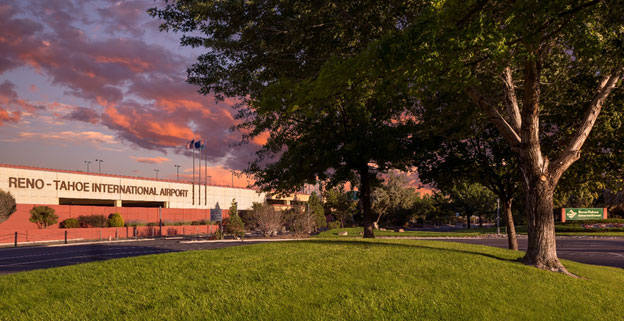
 The Reno Tahoe Airport Authority (RTAA) has been meeting the challenges of a changing industry by integrating sustainability principles and practices into all aspects of airport management and operations since 2008. Over the past five years, a more formal approach has been paying off. RTAA sets its course through a sustainability plan and reports progress through annual sustainability reports. These documents also help to focus efforts and investments. RTAA also believes that a positive corporate culture and engaged workforce are essential to achieving their goals. For an organization that moves 4.45 million passengers each year through the Reno-Tahoe International Airport (RNO) and Reno-Stead Airport (RTS), this is no easy feat.
The Reno-Tahoe Airport Authority embraced an industry framework, the Airport Council International’s EONS management system, to guide sustainability policies and practices. EONS – an acronym for the focus areas of Economic Viability, Operational Efficiency, Natural Resource Conservation, and Social Responsibility – addresses a range of issues from planning, design and construction to operations and management. The RTAA effectively addresses each of four areas with specific initiatives and targets. The initiatives also support RTAA’s strategic priorities.
The most recent annual sustainability report published in 2019 outlines each initiative, the benefits derived, specific targets, implementation strategies, and achievements made. Each initiative may address one or more of the focus areas. While we encourage you to learn more by reading RTAA’s report, here are a few highlights:
Economic Viability
- Maintain strong and stable financial condition: Accounting and finance practices ensure day-to-day operational expenses are covered, they also help RNO and RTS to remain cost competitive, ensure an ability to retain and expand air service, and allow for investment in capital improvements.
- Quantify the economic impact of RNO to the regional economy: Independent analysis demonstrated RNO contributes $3.1 billion in annual economic impacts on the region; creates 24,700 airport connected and supported jobs (4,127 direct jobs at RNO and RTS); and generates more than $51.2 million in revenues for governments in Nevada each year from airport operations, related industries, and visitors.
Operational Efficiency
- Reduce high-energy use lighting fixtures: LED lighting retrofits have reduced lighting energy usage by approximately 37%, saving 389,578 kilowatt hours annually and resulting in annual energy cost savings of approximately $252,000.
- Update building control systems: Automating and integrating an upgraded building control system reduced energy usage by 15%, saving 145,000 kilowatt hours annually.
Natural Resource Conservation
- Reuse and recycle asphalt paving: Reusing asphalt pavement as stabilizing course or aggregate base at the RNO Rental Car Facilities Asphalt Rehabilitation project repurposed nearly 30,000 tons of asphalt.
- Implement water audit recommendations: RTAA strives to reduce single-use plastic water bottle use by installing three water bottle refilling stations at RNO, and conserved water by replacing 30 water-efficient fixtures.
Social Responsibility
- Establish job-shadowing and career development program: A comprehensive program provides opportunities for current employees to Job Shadow and participate in activities that support career development, which supports RTAA’s succession planning efforts.
- Develop and improve travel education platforms: Improving the air travel experience for individuals with intellectual and developmental disabilities through the Wings for All Program helped more than 30 families in 2018 by offering air travel “practice runs” designed to ensure a positive travel experience.
 Interview with President and CEO Marily Mora
Marily Mora, President/CEO of the Reno-Tahoe Airport Authority, shares her perspective on RTAA’s commitment and approach to sustainability, a few accomplishments that she is particularly proud of, future initiatives that will help to advance their goals, and what travelers can do to support RTAA’s Sustainability Plan.
How did sustainability become a focus for the Reno Tahoe Airport Authority?
We believe that a healthy natural environment plays a crucial role in the strength of our economy and our quality of life, and is essential for the sustainability of the aviation industry. The RTAA focuses its sustainability program on four connected areas: Economic Viability, Operational Efficiency, Natural Resource Conservation, and Social Responsibility (EONS). Some sustainability initiatives fall into more than one bucket – the rest, into all four.
Why do you think it is important for the RTAA to develop a sustainability plan?
Development of the RTAA’s sustainability program was important because it provided a new framework to go beyond the success of the RTAA’s existing Environmental Management System (EMS). Given the strategic plan priorities, goals, and the environmental programs in place, sustainability afforded us the opportunity to address the interconnections between the airport’s EMS initiatives and the local, regional and global efforts to create more sustainable communities. As a result, sustainability concepts and practices are integrated into the day-to-day management practices that help to ensure the long-term viability of the Reno-Tahoe International and Reno-Stead Airports.
Which initiative from the third annual sustainability report are you most excited about and why?
I am very excited and pleased with all of the sustainability initiatives that are presented in the RTAA’s 3rd Annual Sustainability Report. The RTAA looks at sustainability with a holistic approach so that not only traditional sustainability initiatives that reduce environmental and economic impacts are employed. Airports function in a social setting and our customer base is diverse and includes internal and external stakeholders. Therefore, both social and operational sustainability initiatives are just as important as the traditional types of sustainability initiatives.
I am probably most proud of our social responsibility initiatives that enhance the customer experience, while fostering understanding of the value that airports provide to the community. For example, our Wings for Autism program that introduced disabled young people to travel won an award from our airport industry peers across North America.
What do you hope to see included in the RTAA’s future sustainability initiatives?
I hope the RTAA’s future sustainability initiatives will continue to align with the holistic sustainable approach to managing an airport. Future sustainability efforts should provide the RTAA with the opportunity to celebrate our commitment to a better community while helping achieve greater organizational success.
What are some ways that residents can support the RTAA’s sustainability initiatives?
I believe one of the best ways airport users can support the RTAA’s sustainability program is by recognizing what they are bringing with them to the airport. Travelers can generate a lot of waste from materials that are not allowed through security, such as beverage containers and other types of restricted items.
- Learn more about RTAA’s Sustainability Approach
- Read the RTAA Annual Sustainability Report 2018
- Explore the City of Reno’s Sustainability & Climate Action Plan
- Sign up for updates on Reno’s sustainability and climate news