I first met Tom Drakulich at Wedge Ceramic Studios, a workspace he uses in addition to the ceramics studio at the University of Nevada, Reno. As I walked in, I immediately noticed his immense focus on a new ceramics piece, carving intricate designs and preparing it for firing. I was unfamiliar with ceramics, my only exposure being a few pottery painting classes on elementary school field trips. Drakulich’s space and creative process were new and perplexing, causing me to quickly develop a newfound appreciation for the broad variety and influence of visual arts.
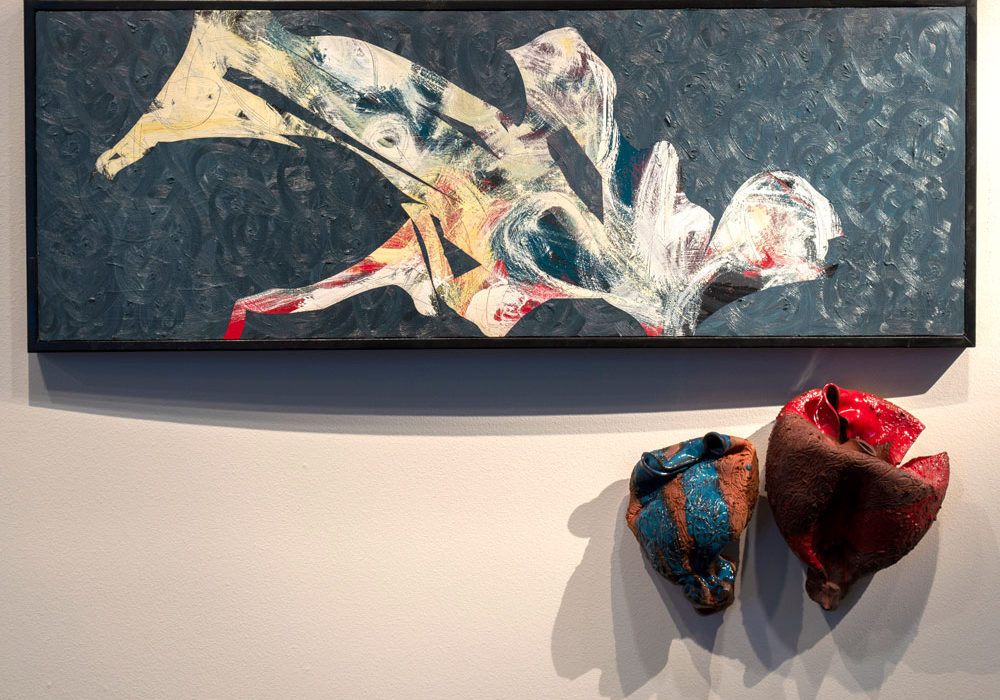
The City of Reno Arts and Culture Commission began the City Artist Program in 2019, selecting Drakulich as the first visual artist within the program. The goal of the City Artist Program involves the promotion of visual artists in Reno and the engagement of the public with visual arts. Drakulich focuses on figurative abstraction, interweaving various mediums while considering the familiar and unfamiliar.
In this Q&A, Drakulich details his beginnings in the arts, describing his education, his struggles and his motivation for becoming a visual artist. Additionally, he explains his experience as City Artist and his goals for his term.

What initially drew you to ceramics and mixed media?
I was really interested in abstraction and I saw some glazes with all the drippy, you know, I saw some cups with really drippy glazes. I was like, oh, that’s cool. That might be a neat, way to navigate abstraction or something like that. And so I went and I was going to do sculptures and then everybody was making fun of me because it was like a pottery class. And I was trying to make a little figure something. And so they’re like, well throw pots. And so then I did. I realized that the same sort of connection between the drippy glazes and abstraction and sort of the physicality of throwing pots were super attractive to me.
You started your education with an Associate in Art History, then moved on to a Bachelor’s in Pre-Law. Why did you decide to pursue an MFA?
When I graduated with my BA, I was considering going to law school pretty seriously. But I took a year off and did ceramics throughout.
I kind of just hung with Richard Jackson and everybody at the [University of Nevada, Reno] ceramics lab. I built up a portfolio and, you know, I sort of started navigating those circumstances. You know, what was really important to me about art, what was really important to me about what my future career would even be.
I’d always kind of been interested in teaching anyway. So I was like, you know, maybe this would be a good avenue. I can jump in there. And if, you know, it doesn’t really work super well, I can always go to do law school later if I wanted to. Of course, you know, within that year span, I was hooked on everything. You know, I just basically spent a full year just making pots, like actual pottery pots, you know, and building up a portfolio of high art sculptures. I was kind of balancing these two things. I knew I was never going to do anything else.
Probably the important thing about that w as that I was really, really excited about it. I did really well in pre-law. And if I spent some time and really studying my LSATs, I probably could have gotten in. But I talked to Fred Reid, who is the old [ceramics] lab technician at UNR, and I was like, hey, man, I’m thinking about doing the MFA. I’m kind of thinking that I want to build up my portfolio and I kind of want to, you know, apply to this and just see how it goes.
He’s like, you know, you don’t really want to haphazardly jump into this thing. Being an artist is not a fun career.
It’s tough. It’s a really hard way to make a living. It’s really hard to just survive in general. You know, it’s all over the place. You’re on your own there. All these constraints. He basically boiled down. He’s like, look, if you’re okay being broke and miserable for the rest of your life and you think it is that important to do art, then do it.
So that was what he posed to me. I thought to myself, well, fine, I did. So that was kind of the long story of it, just a lot of sort of back and forth, but always rooted in the idea of learning philosophy, learning history, learning how to fill particular skills that were super important to me. So pre-law gave me all that. The art history stuff gave me all of my art stuff. And then, you know, going into the MFA, I got to learn how to be a studio artist, which going in, I did not know anything.
What tends to be your process going into your art pieces?
I’m totally an internal artist. When I started the MFA, I thought there are these structures that I need to follow and these things that I need to sort of adhere to. And I realized kind of quickly that that’s not, you know, that may be a good post-modern method of working, but it’s not the right method of working for me. What I realized about me is that I’m process-based. I push things, I push paint, I push clay. That’s kind of the nature of me.
I’m a super physical worker. So finding ways that I can build a full body of work out of something as simple as like drawing hearts over and over and over again are the things that matter to me in thinking about sort of the contrasting nature of how humans interact with the world. That makes a little sense to me. You know, our own interactions don’t make sense to me. The ways we view and relate to each other don’t make a lot of sense. So building these sort of levels of contrast are really interesting. And so it’s all about process and all about just that sort of really physical method of working.
What are your thoughts towards the City Artist Program?
It’s super interesting. Right. Like, I think that all of these little things like that, you know, once again, the City Artist Program are just amazing because it helps to stratify levels of expression, helps to break everything apart and give us all these little moments where we can share ourselves with the community, which is, you know, the goal of an artist.

What are some of your goals as City Artist?
You know, just to be able to really interact with the community a little bit better. I mean, I’ve had a couple of really funny things happen. So I’m helping jury a show for this company, High Sierra 3D, and they’re putting together this really interesting sort of business model where they’re doing 3D models of amateur artworks that they can they can basically just display. I’ve had the chance to be able to interact with people and get them connected with everybody that I know.
I’ve had a couple other calls where I got to go meet people from the city that I didn’t know and talk about some of the things that I’m talking to you about. You know, like some of these difficulties of being an artist in Reno and some of the things that are really, really important, you know, like just looking at the diversity that we have and being able to prop that stuff up.
My big, big goal would be able to share the things that I think are really, really important about my product, my practice and the things that have shaped my practice. But also be able to have moments to talk about how important, you know, the diversity and sort of freedom of expression in the Reno’s art community.
Written by: Emily MacDiarmid, Intern for Arts, Culture and Events