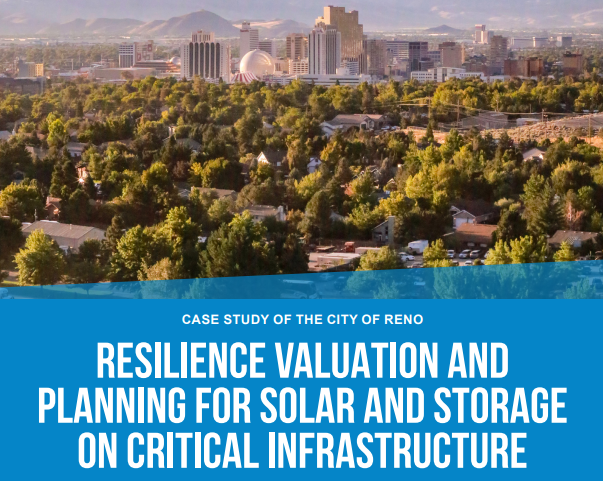
Climate Action aims to reduce cause (reducing fossil fuel use, for example), reduce harm (resilience), and/or restore the environment (plant trees, for example). We can determine or measure the payback and benefits of solar projects, for example, but placing a value on “keeping the lights on” is a much harder task. In order to determine the added benefit of valuing resilience, the City of Reno along with partners from the University of Nevada, Reno and Ameresco, embarked on a journey to do just that. The result is a Case Study co-authored by the National Renewable Energy Laboratory and Converge Strategies.
On June 1, 2020, the Reno City Council approved its first ever solar plus storage project at the new Public Safety Center. The project will ensure this facility can still meet the needs of the community during a prolonged electrical outage.
Read the full Case Study Resilience Valuation and Planning for Solar and Storage on Critical Infrastructure.
Executive Summary
In 2020, the City of Reno (the “City”) was selected by the U.S. Department of Energy’s National Renewable Energy Laboratory (NREL) to participate in a collaborative research effort to develop novel applications of solar energy and other distributed energy resources in unique locations and contexts. The City of Reno team, which included the City’s Sustainability Program, the University of Nevada, Reno (UNR) and the renewable energy and energy efficiency company Ameresco, was one of just eight teams selected to join Round 2 of the Solar Energy Innovation Network (SEIN) program.
At the beginning of the SEIN program, the city-led team aimed to develop a replicable methodology for calculating a monetary value of resilience (i.e., a concrete dollar amount) that solar and storage could provide at Reno’s new Public Safety Center and deliver a proof of concept for monetizing resilience benefits through an energy performance contract (or other contracting mechanism) to facilitate solar-plus-storage procurement. Through research and in-depth discussions with multiple city stakeholders, and the City ultimately determined that it would not need a quantified value of resilience and standard quantification methodology to pursue solar and storage development at the Public Safety Center. Instead, this project resulted in (1) a more refined set of parameters under which the City might pursue resilient energy infrastructure investment, (2) a clearer understanding of the various resilience factors and scenarios to be analyzed, (3) robust dialogues across previously siloed City operations and departments, and (4) the discovery and successful award of new funding sources for future resilient solar and storage projects.
This case study report documents the City’s project evolution and the entrepreneurial ways through which the City approached the questions of how solar and storage could support their resilience efforts and how to value and pay for solar-plus-storage systems. This report documents how and why the City of Reno came to the specific conclusion to integrate solar and storage into their Public Safety Center retrofit project and apply for Federal Emergency Management Agency (FEMA) Building Resilient Infrastructure and Communities (BRIC) funding. (The City of Reno applied for and was awarded FEMA BRIC funding in January 2021; leveraging work that was underway in this project.) This report provides an overview for other local governments to draw inspiration from when considering how to prioritize community values and pursue multi-stakeholder dialogue around resilient energy solutions. The City of Reno’s experience can serve as a starting point for other communities interested in valuing the resilience benefits of solar and storage.