We have a special request. Advocate for urban trees. Today, over 55% of the world’s population lives in urban areas. According to the UN, that is expected to increase to 68% by 2050. Urban trees play a vital role in the health and wellness of those residents, and equitable distribution ensures all residents enjoy the benefits provided by trees, improves neighborhood character, and provides cooling relief during summer.
Trees are the simplest, cheapest and most effective thing we can do to counteract Nevada’s changing climate and reduce Reno’s urban heat island effect. Not only do trees shade our lands, but they also suck up carbon dioxide, a heat-trapping gas, and add back oxygen, helping us to meet air-quality goals. They create wildlife habitat, filter noise, reduce stormwater pollution, and beautify our homes, parks and open spaces. Given the stresses of our ever-changing world, trees provide rare sources of respite. Homes that back to greenbelts see 10-15% higher property values.
Reno has the dubious distinction of being one of the fastest-warming cities in the U.S. over the last 50 years, with a more than 7-degree increase in that time (ClimateCentral.org). Given our recent summers with months of back-to-back 95-degree days, it is no wonder that air conditioning is being installed in older homes more than ever before.
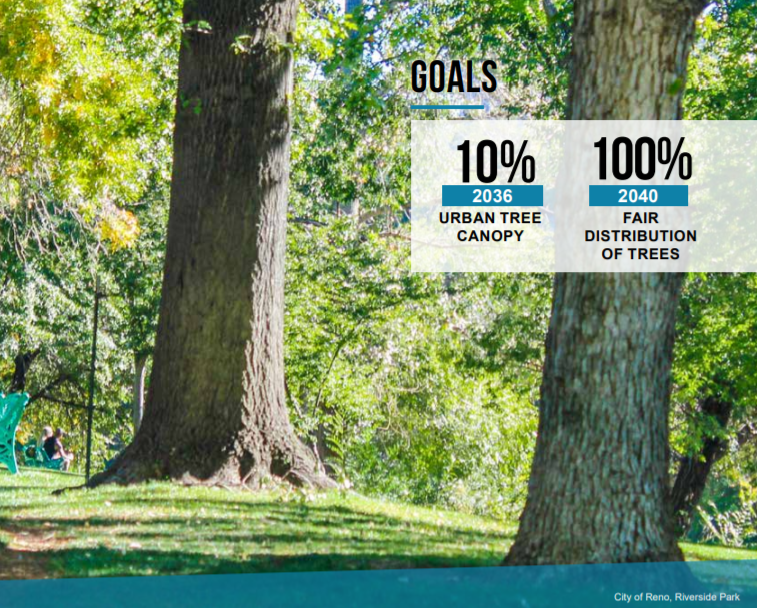
In 1982, Reno became the first city in Nevada to earn Tree City USA designation. While still recognized as a Tree City USA, Reno’s canopy coverage is low. American Forests recommends 15% canopy cover as a baseline for desert cities. Enhancing the urban forest canopy in Reno requires the combined efforts of the city government, community fundraising, committed volunteers and homeowners who are mindful of the value of trees.
Tree Protection and Preservation
The City is taking action to adopt best practices in tree planting specifications and preservation, and incorporate international best practice specifications and requirements for tree protection and preservation.
Current issues the City faces are:
- Required landscaping being removed or damaged (ex. topped) outside of permit process
- Landscaping not always installed according to plans or standards, reducing likelihood of long-term survival
- Tree protection standards only apply to front yard/street trees and only during construction
- Uncertainty in tree protection thresholds, valuations, maintenance responsibilities, and penalties
- Limited resources for implementation & enforcement
We can fix that. The City is well underway with the ordinance process to update Chapter 8.32 and Title 18. The goal with this ordinance is to protect the tree canopy within the City by supporting the retention of healthy trees and specifying replacement requirements for trees that must be removed. Overall, it clarifies and expands tree protection standards (keep the tree where possible, protect the roots), clarifies maintenance responsibilities (plant the right tree in the right place, use sufficient quality and quantity of soil and water properly), and streamlines procedures and enforcement.
You can follow the progress of the proposed ordinance by visiting reno.gov/trees.
The City is taking additional action under ReLeaf Reno which is a City-sponsored program designed to preserve and expand Reno’s urban forest.