
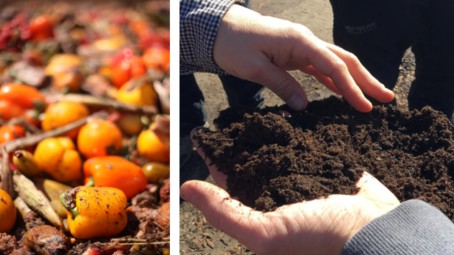
You may be asking yourself: What is the point of composting when waste just decomposes in a landfill anyway?
While food does eventually break down in a landfill, the results of landfill pile and compost pile are vastly different. In a landfill, the food waste is mixed and buried among many different types of material. This prevents exposure to the proper amount of oxygen needed for decomposition. Instead, landfills contain high levels of methane, a greenhouse gas that has a global warming potential that is 21 times higher than carbon dioxide. On the other hand, traditional compost piles need four main ingredients:
- Water
- Oxygen
- Nitrogen (green materials)
- Carbon (brown materials)
These ingredients are broken down by microorganisms which generate heat and speed up the breakdown process even more. The end result is a dark, crumbly, sweet-smelling, organic matter called humus. It can be used for potting soil, garden beds, etc.
More than 40% of municipal solid waste (MSW) in landfills is comprised of organic material that could be used for compost, according to a study by Washoe County Health District in 2018. For residents of Reno, it is important to understand how we can minimize our contribution to waste production, especially in an urban setting. Composting may seem intimidating at first; however, once it is part of your routine, it is easy and very low maintenance. This action directly aligns with the City Sustainability Plan, Priority 5.4: Compost green waste and food waste.
“A change in local behavior is needed to help achieve zero waste. There is hidden value in composting food and green waste,” said Ward 2 Councilmember Naomi Duerr. “One of the best ways is to show the community how and what can be composted.”
Composting can be confusing which can lead to hesitation to begin at home. However, the majority of the following materials are found within or around most households:
- “Browns”- dead leaves, branches, twigs, wood chips, sawdust, fireplace ashes (refer to local fire safety guidance before handling ashes), coffee filters, paper products (shredded newspaper, tissue, napkins, paper towels, cardboard, toilet paper), cotton/wool rags, straw, cornstalks, pine needles, plants/flowers.
- “Greens”- grass clippings, fruits, vegetables, vegetable/fruit scraps, coffee grounds, eggshells, biodegradable tea bags, nutshells, bread/pasta(with on dairy or oil) house plants, weeds, seaweed, manure, or hay.
While there are many acceptable household items for composting, there are many that cannot be tossed into that pile:
- Pet or Human Waste – may contain parasites, bacteria, pathogens, and viruses
- Yard clippings treated with chemical pesticides – may kill beneficial composting organisms
- Meat – creates odor and attracts pests
- Bones – creates odor and attracts pests
- Fats, grease, lards, oils, cheese – creates odor and attracts pests
- Plants with disease and/or insects – can potentially transfer disease and insects
- Dairy Products – creates odor and attracts pests
- Coal or charcoal – may contain harmful substances
- Black walnut tree leaves or twigs – releases harmful substances
- Whole branches/logs – takes too long to break down on its own
- Plastics(including plastics certified as compostable) – does not decompose or is designed to degrade in an industrial composter
- Sanitary Products -may contain plastic or chemicals
- Mixed Materials (ex: Magazines, Greeting Cards, wrapping paper, etc)- often coated with plastic
Another important consideration is what composting method to use. This part is completely up to you! It can be as simple as a pile in your backyard or as complex as a compost tumbler. There are some you can purchase premade as well as many DIY options depending on your budget, skill level, time commitment, and space. In other words, there is no right or wrong way to compost. In fact, even the most experienced composters will need to occasionally troubleshoot a problem. For example, if your compost is not heating up, try adding large volumes of browns and green. If your compost is too dry then add greens and water. If your compost is too wet, add browns or decrease greens. If you notice foul odors, then add more browns. If you notice pests, then add more browns and bury food scraps.
Composting can be a fun and educational activity for your whole family. In an effort to educate the community and promote awareness, Councilmember Naomi Duerr will host a neighborhood cleanup later this month. The cleanup will feature a green waste disposal bin in which all of the material will be taken to a local commercial composting facility. The bins have been graciously donated by Waste Management.
Photo credit: Full Circle Compost
Blog by Kayla Hechtel, Intern for the City of Reno City Manager’s Office, Sustainability Program, with contributions by City Staff.