
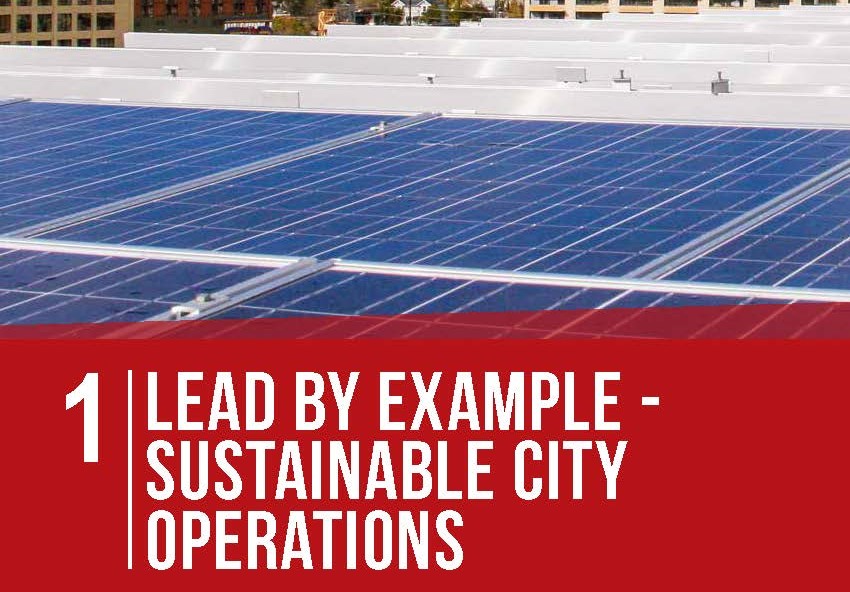
Sustainability & Climate Action Plan Goal 1.13
About the Solar Energy Innovation Network
Last year, the City of Reno (City) announced it was selected by the U.S. Department of Energy’s National Renewable Energy Laboratory (NREL) to participate in a collaborative research effort to develop novel applications of solar energy and other distributed energy resources (DERs) in unique locations and contexts. The City-led team set out to place a resilience value on solar plus storage applications, and determine how that value could be applied to Energy Performance Contracts or other contracting mechanisms in order to more accurately weigh the importance of resilience solutions against other City priorities and finance solar and storage projects from an emergency management and resilience standpoint. The City team, consisting of the University of Nevada, Reno (UNR) and Ameresco, with support from NV Energy and the Governor’s Office of Energy, was one of just eight teams selected to join the Solar Energy Innovation Network (Innovation Network).
“We selected teams that are experimenting with creative, promising ideas to use solar power in rural communities or in commercial-scale applications,” said Eric Lockhart, who leads the Innovation Network at NREL. “The work of these teams will provide a blueprint for other communities pursuing novel applications of solar energy.”
City Perspective and the Study
Local governments struggle with the upfront cost of infrastructure necessary to be prepared for a disruptive event. These events affect the basic functions of local infrastructure, therefore greatly affecting our community. The City of Reno was interested in incorporating renewables at the new Public Safety Center, but more specifically in exploring what role solar plus storage could play during a disruptive event.
While the City of Reno evaluated the potential and payback of solar and storage at its new Public Safety Center, UNR was researching and developing a Value of Resilience for the same location. The UNR team considered events that last for more than 24 hours in developing metrics for resilience valuation. They determined that both the payback and value of resilience of solar and storage can be stacked to determine the total benefits of the system.
“One of the most innovative, nuanced aspects of this project is that the City team is breaking down the ‘solar must pay for itself’ dynamic and starting to shift the perspective to considering solar and storage as a necessity due to its resilience value,” said Tim Farkas, the Finance Director for Ameresco and Financing Lead for the project team.
The Outcome
The analysis will provide a value for resiliency based on the probability of a disruptive event in the Reno area. These events are unpredictable, so there is no way to say exactly when a resilience value will be realized, but there is enough data to support infrastructure changes to mitigate the impacts of potential disruptive events. By quantifying the risk of a shutdown from a disruptive event, we are better able to prepare for and manage the situation before it happens. Traditional cost-benefit analyses rarely prioritize prescriptive measures to mitigate event impacts, so being able to assign a dollar value to the resilience benefits of solar and storage projects opens the door to ensure that the City can make better investment decisions with better data. As a result, several pathways for incorporating the value of resilience of solar plus storage were identified by the team.
Upon conclusion of the project, the City team will release a Resource Library which will include:
- City of Reno Case Study which articulates the need we saw for developing a value of resilience to better evaluate solar and storage projects within the City.
- A Value of Resilience of Solar + Storage study consisting of the valuation methodology developed by the UNR, and a use case applying that value to the Public Safety Center.
- Tools for Managers Value Model Checklist and Methodology, which describes the technical valuation piece in a more accessible language for non-technical audiences such as City Managers, Sustainability Managers, Emergency Managers, and Planning Professionals.
- Pathways for Monetizing Resilience Value: Quick Reference Guide that will highlight important questions and nuances to each pathway the team identified.
- Pathways for Monetizing Resilience Value: Full Analysis that will go into more detail on each pathway, including policy considerations, how the value is realized, stakeholder engagement, and use cases.
The City of Reno team hopes to continue to build and share the Resource Library beyond the conclusion of the Innovation Network program, which wraps up this spring. The project is not yet complete, but has already informed amendments to C-PACE (Commercial Property Assessed Clean Energy) legislation and Energy Performance Contract legislation. The process also aided the City in applying for a grant to incorporate these technologies at additional locations.