
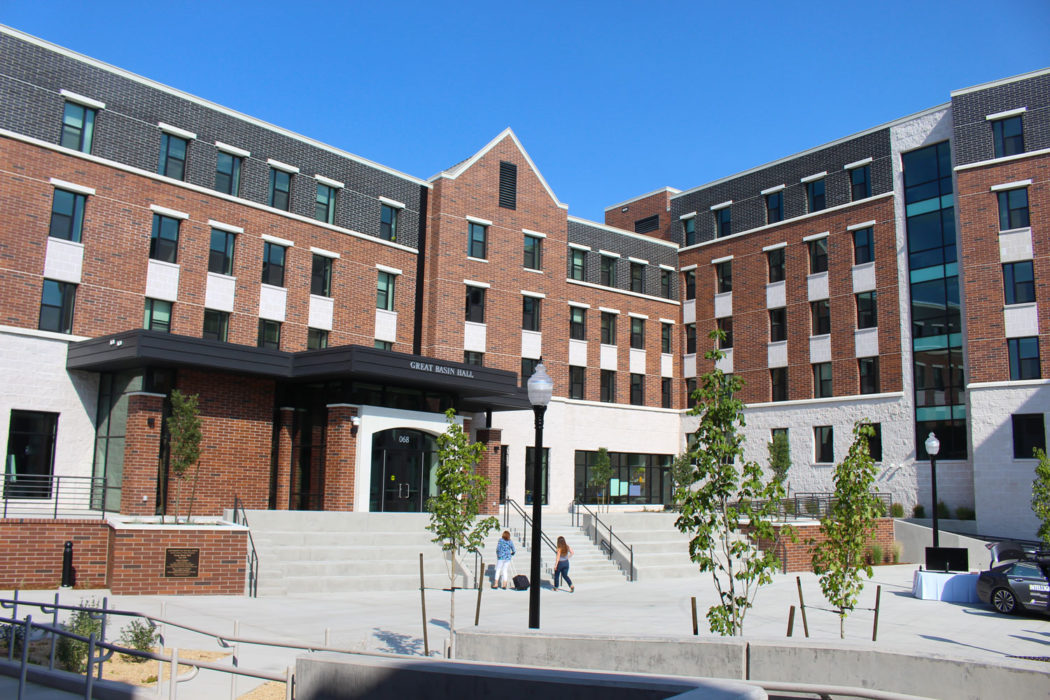
On August 27, the University of Nevada, Reno welcomed in an estimated 3,000+ freshman. At the end of their first day of classes, many came back to the newest dorm hall on campus: Great Basin Hall. The dorm, under construction since 2016, replaces White Pine Hall and increases the amount of students that can reside in the space from 100 to 400.
The new resident hall will help accommodate more students as the University continues to grow. Great Basin Hall was named to pay tribute to the Native American homelands in the Great Basin region. In a brief interview with Nevada Today, Shannon Ellis, Vice President of Student Services, highlights the important historical context that comes with the name. “Through the naming of Great Basin Hall, the University of Nevada, Reno recognizes the traditional homelands of the indigenous peoples of Nevada and acknowledges the tribes of the Great Basin who historically and currently reside in the state of Nevada: Newe (Western Shoshone), Nuwu (Southern Paiute), Numu (Northern Paiute) and Wa She Shu (Washoe),” Ellis said.
The new residence hall is reserved for STEM majors, primarily focusing on newer students, while a small percentage of upperclassmen will be residing there as well. By focusing on STEM students, the hall encourages students to form strong bonds with peers, building positive academic relationships that can lead to better study habits and ultimately, creates a supportive student environment.
While the focus is on the students and the dorm hall is well-supplied with multiple study rooms and computer labs equipped with STEM-related software, the building’s structure is equally as impressive. The new hall, designed by Reno-based architecture firm Van Woert Bigotti Architecture and constructed by CORE Construction, had LEED Gold certification in mind from the start. The team also hired Brightworks Sustainability to help with the LEED process. Great Basin Hall was designed and constructed to achieve a LEED Gold certification, and will join the ranks of other LEED certified buildings on campus like Peavine Hall (Gold, 2015), Nevada Living Learning Community (Silver, 2012), and Marguerite Wattis Petersen Athletic Academic Center (Silver, 2008).
“The process of becoming LEED certified starts long before and during the design process,” according to Danielle Fabri, AIA, architect for Van Woert Bigotti. After construction is completed, it can take anywhere from six months to a year for the process to finish. The new resident hall incorporated energy and water saving systems, such as LED lighting, natural daylighting to reduce the need for interior lighting during the day, energy-efficient windows, and low-flow water fixtures. It also features a variety of recycled building materials.
The new resident’s hall is a continuation of the University’s effort in accordance with its Sustainable Building Policy to incorporate LEED principles in the design and construction of any new building. Since revising its environmental and sustainable building policies in 2006, the University has held a strong stance on the importance of environmental sustainability.
Construction is underway for two new buildings, the University Arts Building and the William N. Pennington Engineering Building, and even more projects are on the horizon for the University, including expanding the south end of campus to form a new “Gateway District.” We hope to see that both the University Arts Building and the William N. Pennington Engineering Building both achieve LEED certification in the future.
Written by Joe Staples, Communications Intern at the City of Reno