
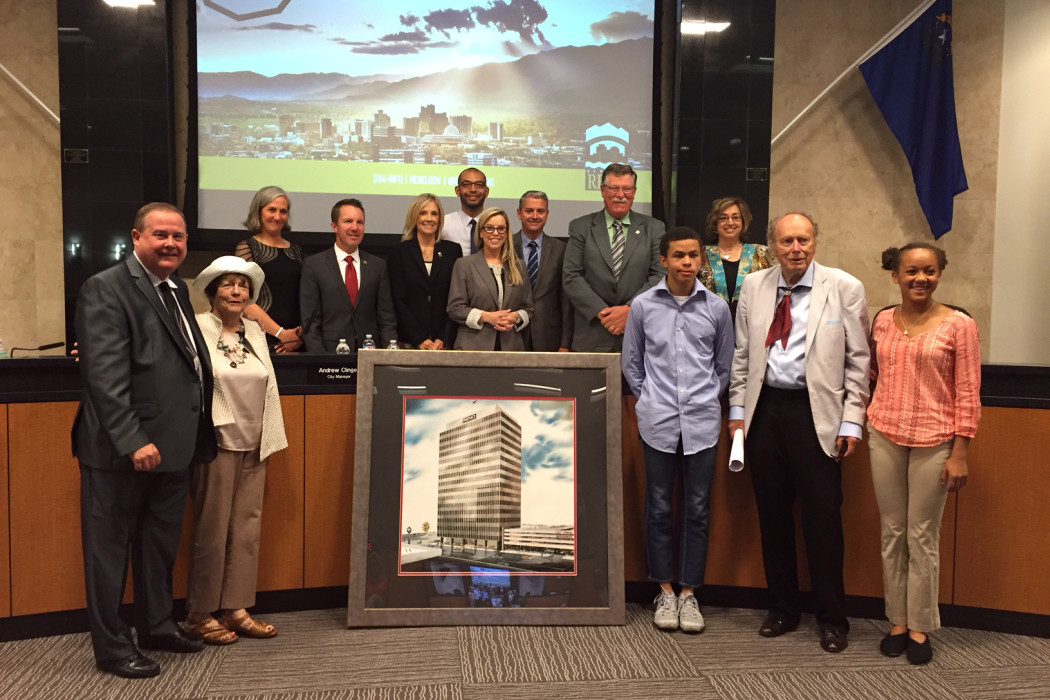
On Wednesday, July 20, 2016, the William Thornton family and Club Cal Neva, through Jeff Siri, presented the City of Reno with an artist’s rendering depicting the City Hall building in downtown Reno. The rendering was completed in 1964, but was recently updated to include the clock that sits in the Plaza in front of the building. The rendering will hang in the first-floor lobby of City Hall, located 1 East First Street in Reno.
Historical information below provided by K. Breckenridge (kfbreckenridge@live.com) and does not necessarily reflect the views, opinions, or positions of the City of Reno.
On October 26, 1963, a northern Nevada icon was born. The First National Bank of Nevada, then the state’s “$400 million partner” commissioned the construction of the building, to be its statewide headquarters. Curiously, the bank’s former “Main Branch” at Second and Virginia Streets, a block to the north, would remain as the preferred branch of the bank’s premier accounts for years to follow, evidence of either the sentimentality of the depositors’ formative days, or of the cachet and clout to be gained from the “94-1” branch number on their checks. But, the new 16-story building would from that date forward house the central operation of its commerce on the lower four floors, with the fifth floor and those higher immediately leased to some of the Reno’s most prestigious legal firms and commercial tenants.
Let’s learn a bit of the tower structure: The name of the bank’s early-1960s president Eddie Questa figures in several sources as the engine behind building a new bank, on a site occupied by another, smaller FNB branch on the same corner, 1 East First Street. Shareholder approval was gained and deed was done, and the Harding Group engineering firm initiated the task of overseeing the preparation of the site and coordinating the management of construction and utilities to the new building. The architectural firm of Langdon & Wilson, then of LA and now with principal offices in Newport Beach, California, was commissioned to design a bank building. And did they ever; the obsidian glass with bright aluminum window mullions were novel in 1964 and remain unique.
The useable floor area of the building is 160,000 square feet, which when considering the entry floor works out to about 10,000 feet per floor (like most high-rise buildings, 1 East First has no 13th floor).
The vault, with its 18-ton door, is 18-feet-wide by 85-feet-long. Inasmuch as the vault’s floor, ceiling and walls are fashioned of two feet of concrete and rebar, it’s a fair assumption that no matter whatever becomes of the structure, the vault will remain. Parker’s first western store on East Second at Lake Street was also built as a bank with a vault in its basement, which Harry and Mush Parker used as a showroom for Levi’s britches.
The $4.5-million tower construction was a joint venture of the L. E. Dixon Company of San Gabriel, Calif. and the J. A. Tiberti Construction Company of Las Vegas. Both were strong companies with many impressive projects completed on the West Coast. While both firms were domiciled out of the area, the press took great note that the vast majority of the sub-contractors, suppliers and vendors were locally based.
And, like dotting an “I” or crossing a “T,” one of the final acts of construction before it was turned over to the 500 First National Bank employees was the placing of a 42-foot-tall lightning arrestor atop the building. A helicopter was employed for this daunting task, an event not lost on the adoring press. By coincidence a set of pulleys, sheaves and a lanyard were attached to the lightning rod.
Old Glory proudly flew above the Battle Born Nevada flag from that lanyard at the pinnacle of that building, on that autumn day of 1963.
In the years to follow, 1 East First Street was acquired by the Club Cal Neva, and thereafter the office tower was sold to the City of Reno for its current occupancy as Reno City Hall. In 2015, the Club Cal Neva sold the parking garage located at 55 East First Street to City of Reno as the garage is used primarily by the City of Reno, its employees and visitors, and other tenants of the office building. These transactions deserve a column of their own soon when space will permit more information.
It’ll be well worth the trek downtown to see this artwork, in the now-Reno City Hall, the northernmost jewel in the City of Reno’s tiara – the classic Delongchamps post office, the graceful new Virginia Street Bridge over the Truckee River, the antique Club Cal-Neva Ginsberg clock located in the City of Reno Arts plaza across from City Hall and the lobby of this iconic bank building-turned-City Hall.