
In an effort to continue to “Connect Our Community with Our City,” the City of Reno has developed an FAQs program in order to answer commonly asked questions and respond to the issues that are most important to you. If you would like to submit a question for consideration in a future installment of FAQs, please use this submission form.
January 2016 FAQs are below. Read December 2015 FAQs here.
What is the protocol for ice and snow removal on City of Reno streets?
This autumn and winter has resulted in several snowstorms in the Truckee Meadows, which means that Reno Direct and City of Reno staff have received a high volume of calls recently regarding snow-removal, or plowing, operations on City streets.
Answer: City of Reno plowing operations typically begin when the snow depth reaches four (4) or more inches on city streets. Public Works sometimes deploys plows on main street intersections before four inches of snow accumulates if it’s necessary to do so in order to combat icy conditions. Most of the plowing occurs in the higher elevation routes and outlying areas due to the fact that these areas usually receive the most snow accumulation.
The City of Reno street system contains approximately 2,244 lane miles and is divided into 19 routes. Priority is given to arterial and collector streets along with school zones. Secondary streets are plowed after “priority” streets as resources become available. Priority 1 and 2 streets include major streets, collector streets, areas around schools, and emergency service sites (police stations, fire stations, and hospitals).
Examples of Priority 1 and Priority 2 streets, as well as more information on Snow and Ice Control protocol, can be found at Reno.gov/Snow. “Reno Snowplowing Priority” maps are also available there.

Photo by Raj Raghunathan
What responsibilities do homeowners and business owners have to clear sidewalks after storms?
A common misconception is that City of Reno crews/employees will clear privately owned sidewalks, which is false.
Answer: Homeowners and business owners are responsible for clearing sidewalks on their property, as well as the berms that can sometimes block their driveways. Driveways and sidewalks are often affected by snow berms as plowing occurs. This is an unavoidable part of the snow-plowing process. The City does not remove the berms from driveways or sidewalks, as it does not have the resources available to do so.
In accordance with Reno Municipal Code Section 12.20.005, property owners are required to maintain their sidewalks free from any obstructions including weeds, debris, ice, and snow. If the City receives a complaint concerning the obstruction of a sidewalk, Code Enforcement will send out a courtesy letter reminding the property owner of their responsibility. If the City receives a subsequent complaint, a code officer will be assigned and an inspection and further enforcement such as an administrative citation could result.

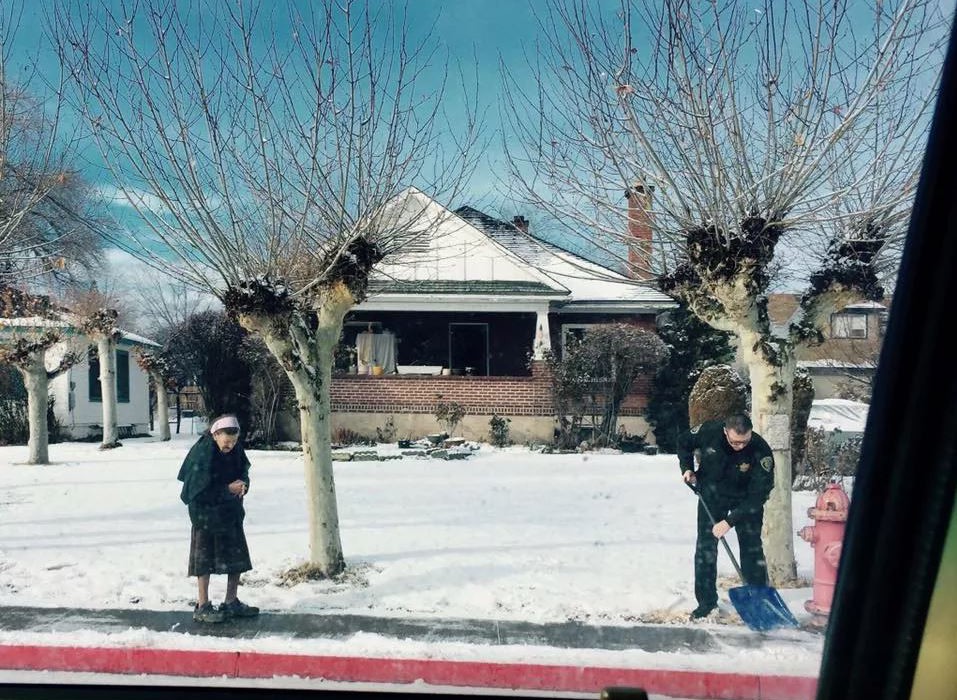
This photo of a Reno Police Department Officer helping an elderly woman shovel her sidewalk was taken in early January. Photo by Matt Lush
How does the City of Reno manage the timing of traffic lights?
Answer: The City of Reno operates and maintains all of the 260 traffic signals located within the city limits, including those located on state highways. In addition, per an Interlocal Maintenance Agreement, the City of Reno maintains all 17 traffic signals in the Washoe County jurisdiction. Retiming signals throughout the region, however, is a cooperative project that includes the Regional Transportation Commission (RTC), City of Reno, City of Sparks, Washoe County, Nevada Department of Transportation (NDOT), and Federal Highway Administration.
The Regional Traffic Signal Operations Improvement Project is designed to reduce number of stops and waiting times at intersections. Approximately one-third of the City’s traffic signals were retimed as part of this project using federal Capacity Mitigation and Air Quality (CMAQ) funds. The plan is to procure yearly CMAQ funding to retime approximately one-third of the City’s signals every one to two years. It is recommended that traffic signal timing be updated every three to five years.
If you have a traffic signal concern, please contact Reno Direct at 775-334-4636, renodirect@reno.gov, or via chat on Reno.gov. Citizens are also encouraged to visit the City’s Traffic Engineering page for more information.
What is the process for getting a new crosswalk installed?
Answer: Per state law, pedestrians have the right-of-way at uncontrolled intersections, regardless if a pedestrian is crossing within a marked or an unmarked crosswalk. Marked crosswalks have to be installed with care, as marked crosswalks alone within higher traffic areas can actually contribute to higher pedestrian crash rates. If you would like to request a marked crosswalk, please contact Reno Direct (see contact info above) to open a request. Once a request is received, engineering staff will review the location and determine the best strategy to improve pedestrian safety.
 What is the new myRPD app, and how can it help prevent crime in my neighborhood?
Answer: The City of Reno released the new myRPD app, available for both IOS and Android users, earlier this month. The community awareness app provides users easier access for filing police reports, submitting feedback, reviewing crime prevention tips, and even navigating to police stations, hospitals, and other community resources. The application will deliver information from citizens instantaneously and directly to the Reno Police Department, which will advance RPD’s vision of being completely integrated into the community. More information is available at Reno.gov/myRPD.
(Note: Citizens should not use the myRPD app to report an emergency; in the event of an emergency, always call 9-1-1.)
For questions pertaining to this article, please call 775-334-4636 or email renodirect@reno.gov. Ask questions on social media using the hashtag #CityofReno.